
Trick question really. When talking about vision, ‘better’ is very ambiguous. Let’s take Cuttlefish for example. They only have one colour sensitive protein, so are technically colour blind. But they can perceive an entire spectrum of information that is far beyond our reach. Known as polarisation, they can see not just light, but the direction it moves in too. This hidden channel of visual communication raises the question, what else are we blind to? Here I want to explore the different visual systems we see across various taxa, why they exist and perhaps question, if our anthropocentric view of the world, is preventing us from truly admiring natures visual complexity.
Butterflies

Now while butterflies can detect light wavelength differences of about 1 nm, an attribute similar to humans, they differ hugely in their colour perception. Humans have trichromatic vision, meaning we have 3 colour receptors: blue, green and red. Butterflies on the other hand typically have 6 or more photoreceptors, reaching up to 15 in certain species. This doesn’t mean each one recognises a different colour, four of them could be used to observe ‘green’, but it does provide them with the ability to perceive millions of colour variations. Could you imagine the colour subtleties you would see and experience with 5 times the number of receptors? And that’s not all, both UV and polarised light are also included in a butterfly’s visual repertoire, putting even those with 20/20 vision to shame.
Why so many? Well honestly, we don’t know. As mentioned before, some photoreceptors are used for distinguishing colour, which of course is vital in pollinators-plant relationships. But as for the others, studies have indicated that they may be fine-tuned to detect fast-moving objects, recognise UV markings in mates and possibly detect changes in nectar availability. With almost 18,000 existing species, a butterfly’s immense visual capability is likely to be a key factor in its success all over the world.
Sharks

The apex predators of the ocean. Surely they must have stand out senses to set them above the rest? A shark’s sense of smell is a hundred times stronger than humans, yet they have no colour vision. Cone cells that are required to detect colour, aren’t even possessed in some species, leaving them totally colour blind. Certain studies have suggested that in a marine environment, visual contrast is more important than colour in object detection and so this may a driver for its monochromatic vision. What a dull lens to view the world through.
But I haven’t told the whole story yet. Much like cats, sharks’ eyes contain a special tissue known as the tapetum lucidum. Ever wondered why a cat’s eyes appear to light up in the dark? This tissue of mirrored crystals is situated behind the retina and so when light enters the eye, it’s reflected, not absorbed. This results in the superhuman ability to see 10x better in the dark than any person, an asset in the dark depths of the oceans.
Eagles
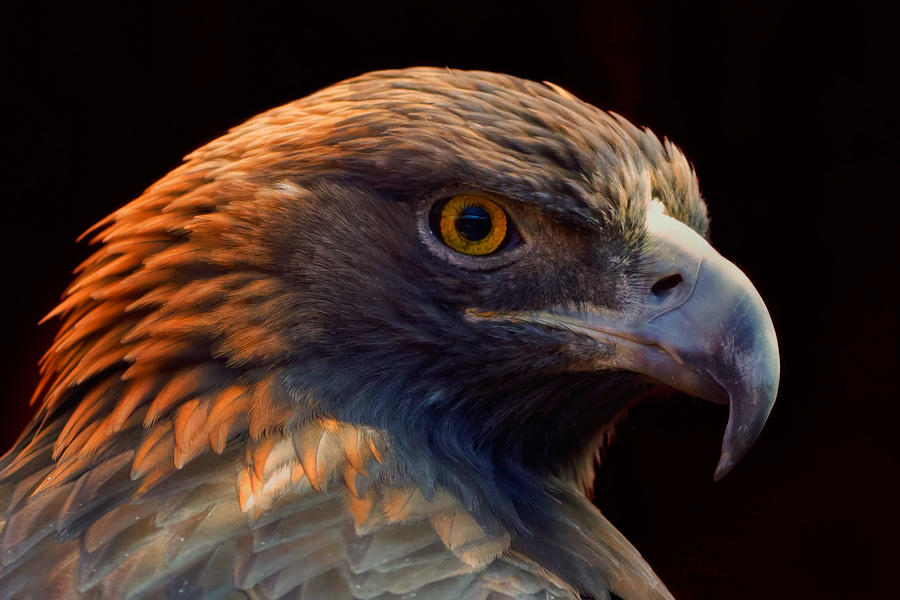
In the light, eagles reign supreme. Their corneas can change shape, literally giving them a ‘zoom’ function, which enables them to better focus on near or far objects. We’ve talked a lot about colour, but eagles stand out for their visual acuity. Their retinas are packed with light-detecting cone cells; the more you have the better your vision. Akin to pixels on a screen, this provides a resolution that enables them to see camouflaged prey from miles away.
But just how good is it? Well if humans had the vision of an eagle, we would be able to see an ant crawling on the ground from the roof of a 10-story building. 5 times ‘better’ than us, an eagle’s 20/4 vision makes it one of the most efficient predators of the sky. A common trend that runs throughout the animal kingdom, is that of predators having eyes located at the front of their heads. So eagles should be no different? Their eyes are actually angled at 30 degrees away from the midline of the face, giving them a 340-degree field of vision. Well, that tops human vision for sure; we can only joke about ‘having eyes in the back of our head’, for them it’s a reality.
Mantis shrimp

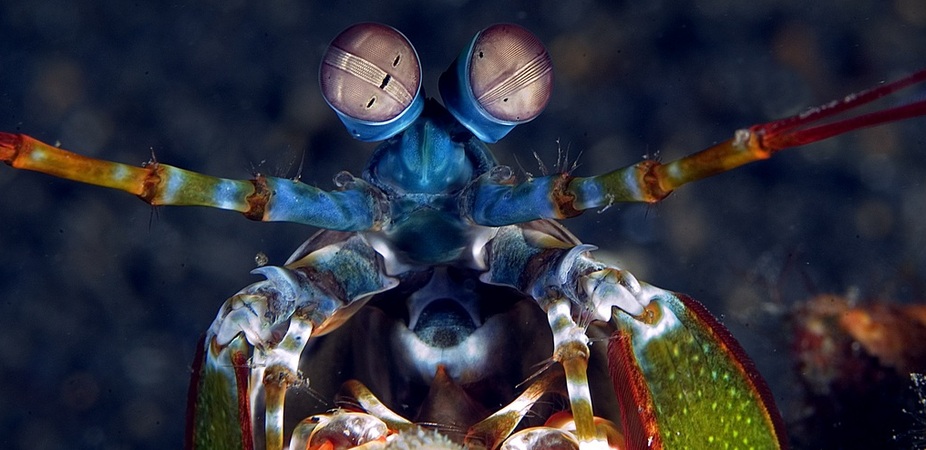
Now this stomatopod needed a whole section dedicated solely to it, it’s just too bizarre. This creature possess 2 compound eyes, each with tens of thousands of units called ommatidia. Perched on stalks, they can not only individually move each eye, but also independently perceive depth. Each eye is literally seeing in 3D. The magic really happens in a strip of modified photoreceptors that vertically run down the centre of their eyes. This ‘mid-band’ contains 12 – 16 different colour photoreceptors, located alongside the most complex UV detecting system found in nature. It has six UV dedicated photoreceptors, each tuned to a different wavelength. The best part? These receptors are connected to different nerves than the ones that detect colour, both streams leading to different parts of the brain. Meaning mantis shrimp didn’t just evolve a ridiculously complicated visual system, it did it twice!
They’re eyes work a lot like satellites. This ‘mid-band’ of photoreceptors is scanned over their subject and the process repeated. Each piece of information is then interpreted and processed within the eye before sending it to the brain; kind of like brushing the floor, stroke by stroke. Much like the cuttlefish and butterfly, mantis shrimp are also sensitive to polarised light. But while many species can detect linearly polarized light, mantis shrimp can perceive circularly polarized light (CP), the one and only species on the planet that has this capability. By possessing body patterns that can produce CP light, they have produced a language that no other organism on the planet can understand, the true secret agents of the animal kingdom.
So which eyes are the best?
While similarities will always be found in nature, no animal will ever be identical. Visual systems are no exception. The rich diversity we see in our ecosystems creates some weird and wonderful eyes, each adapted to best suit the animals needs. While we may never have the ability to: see in the dark, spot an ant from miles away, perceive millions of colour variations or communicate a whole language just through our eyes, we have vision that perfectly suits our environment. There really is no better or worse, just what is required for the survival of a species.
Editor: Adam Nightingale
Sources:
https://pubmed.ncbi.nlm.nih.gov/28332207/
https://sharksinfo.com/sight-html/
https://www.livescience.com/18658-humans-eagle-vision.html
https://www.lasikmd.com/blog/how-does-human-vision-compare-to-that-of-an-eagle
https://www.nationalgeographic.com/science/article/natures-most-amazing-eyes-just-got-a-bit-weirder
https://phys.org/news/2013-09-mantis-shrimp-world-eyesbut.html
 Newscleus