
Below is a shortened version of a 6-month research project in Scotland. The full investigation and list of references can be found at the end of this article
Since the passage of the Land Reform (Scotland) Act 2003, community land ownership has been championed as a radical corrective to Scotland’s historically concentrated pattern of private tenure (Wightman, 2013; Glass et al., 2019). Framed by policymakers as a vehicle for “community empowerment” and “sustainable development” (Scottish Government, 2024), the transfer of land title from private lairds to community trusts is often narrativised as a triumphant political and ecological event. This praise is well-founded; community ownership signals both a political liberation and a material step in addressing the entwined role land plays in our ecological, social, and economic lives (Hall, 2013; Le Tourneau et al., 2024). Yet, despite Scotland standing alone as a pioneer of legislative land reform, a significant gap remains in our understanding of the lived reality post-acquisition. Few studies have documented this evolving relationship (Didham, 2007; Callaghan et al., 2011; Mc Morran et al., 2014), and as the Scottish government comes to champion now 840 assess in community ownership (Scottish Government, 2024a), it must be clear that the true nature of ownership cannot be captured by statistics alone. For to continue viewing ownership as myopically tethered to the number of title transfers is to obscure the complex reality of the ‘post-champagne’ era.
As communities assume the role of landowner, they inherit not only the title but the “mundane responsibilities” of stewardship, from fence repairs to the bureaucratic labour of grant applications (La Grouw et al., 2024). They inherit not just hectares, but a landscape encoded with cultural narratives and group identity (Sauer, 2012; Kimmerer, 2013; Bender, 2024). While Scottish policy focuses on the spectacle of the buyout – the celebration, the flag waving – it overlooks the rigorous administrative compliance and institutional buy-in required to sustain it. Communities do not merely inherit land; they enter into a complex web of procedural obligations and funding architectures that can dictate the rhythm of local life (Dinnie and Holstead, 2018). An ‘institutional Darwinism’ (Creamer, 2015), in which successful buy-outs are tethered to stringent grant conditions, carbon credit schemes, or renewable energy mandates (Sharma et al., 2023). This makes community stewardship more than a static title; it is a lived expression of power and social cohesion (Shipton and Goheen, 1992; Hayes 2020). So as the solution to ecological collapse becomes an increasingly socio-ecological endeavour (Hossain et al., 2024; Le Tourneau et al., 2024), a truthful accounting of this lived context becomes essential to truly understanding community land ownerships’ sustainable potential.
What Makes Land So Special?
The Intergovernmental Panel on Climate Change’s (IPCC) Special Report on Climate Change and Land recognises land as a central component to the climate challenge, and deleterious anthropogenic land-uses (Chase et al., 2000; Zhao et al., 2001; Marland et al., 2003; Foley et al., 2005) are predicted to be a major component of ecological collapse over the next century (Feddema et al., 2005; IPCC, 2019). But land differs from any other resource, for the meaning ascribed to it is neither objective nor universal. The United Nations Convention to Combat Desertification (UNCCD) provides a comprehensive starting point, defining land as ‘the terrestrial bio-productive system that comprises soil, vegetation, other biota, and the ecological and hydrological processes that operate within the system’ (UNCCD, 2017, p.21). Yet it is far from being just a geographical space, its meaning and value can shift dramatically based on one’s culture, wealth, or degree of direct dependence on it for survival (Sauer, 2012; Bender, 2024). It is foundational for the individual on the subsistence family farm, an investment for the wealthy urban dweller, or an arena for geopolitical posturing around the globe. This cultural filtering of meaning demonstrates why any universal approach to land management is unsuitable; it disregards such nuances.
And So Where Does Ownership Fit In?
Ownership of land, at least in the European mind, has been historically monolithically bound to the Western model of individual private property (Home, 2021; Fox, 2024). By the 19th Century, land ownership had become the ultimate Western expression of status, a principle embodied by the aristocratic landowners who dominated institutions like the British Parliament. The ability to own land – and, crucially, to exclude others from it – was a direct manifestation of power, for the lords of the land were also the lords of the law (Hayes, 2020). This validated numerous state-led approaches to land governance, which continuously suffered from asymmetrical power relations, commodification of natural resources, and exclusionary neoliberal governance arrangements that resulted in social exclusion and poor ecological outcomes (Alvarado, 2019; Adams, 2020; Buchadas, 2022). The significance of this concentrated governance of land for Scotland in particular, extends far beyond material possession; it is deeply embedded in the collective memory and identity of its people (Richards, 2000). For example, the trauma of the Highland Clearances resulted in consequences which were not merely physical (starvation, displacement, and death); it severed the bonds of heritage and place that had defined Highland society for centuries (Meighan, 2022). For a landed relationship in this region did not bow to England’s Enlightenment-derived notions of land as a commodified resource (Locke, 1689), instead it was rooted in the Gaelic concept of dùthchas. Land in this form was understood as a conduit for cultural heritage and collective identity, with communities holding an inalienable hereditary right to inhabit and nurture their ancestral clan territories (Dziadowiec, 2024). For Scotland therefore, land reform is as much a question of geography as it is of history (McCrone, 1997). While it has one of the most uneven patterns of land ownership in the Western world (BBC News, 2019a), a true evaluation of community ownership in Scotland must invite discussions beyond those material inequalities and title transferences.
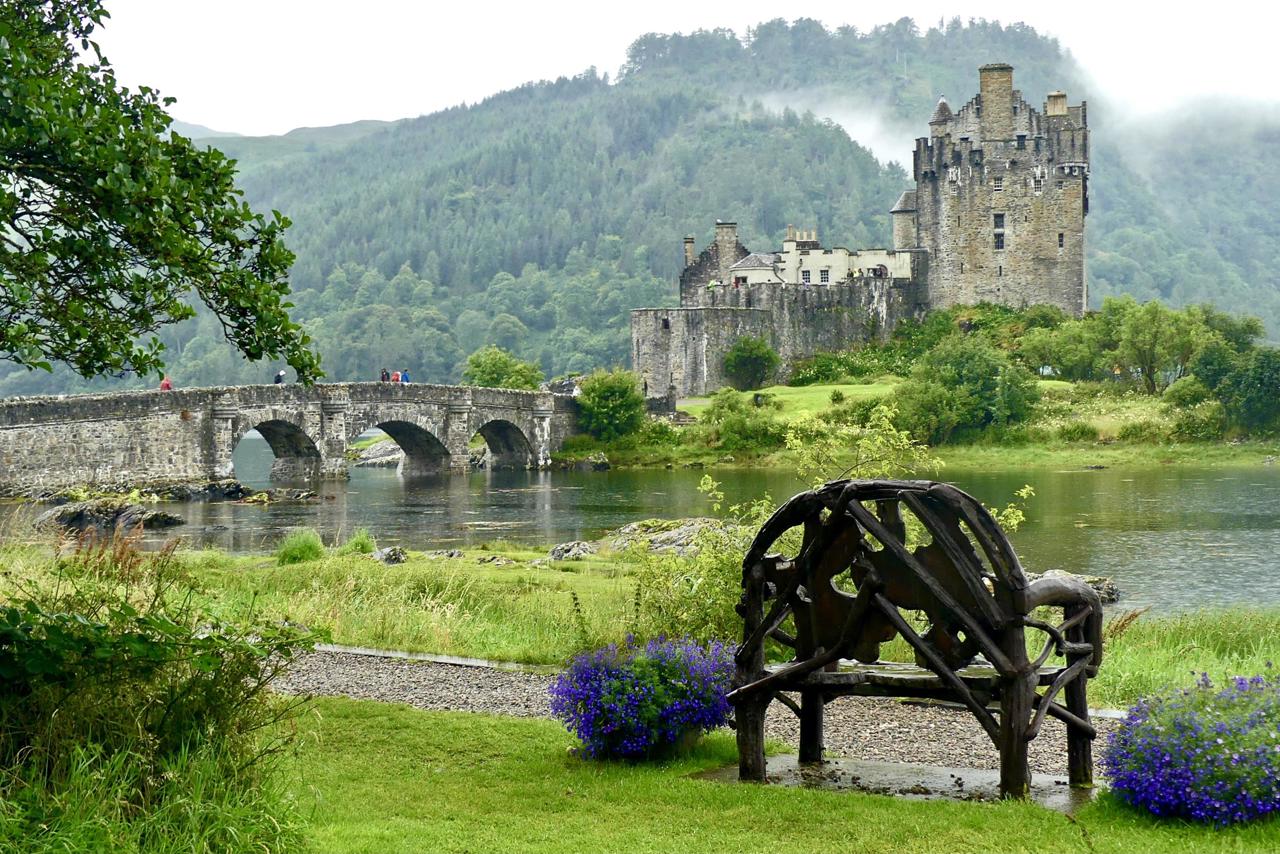
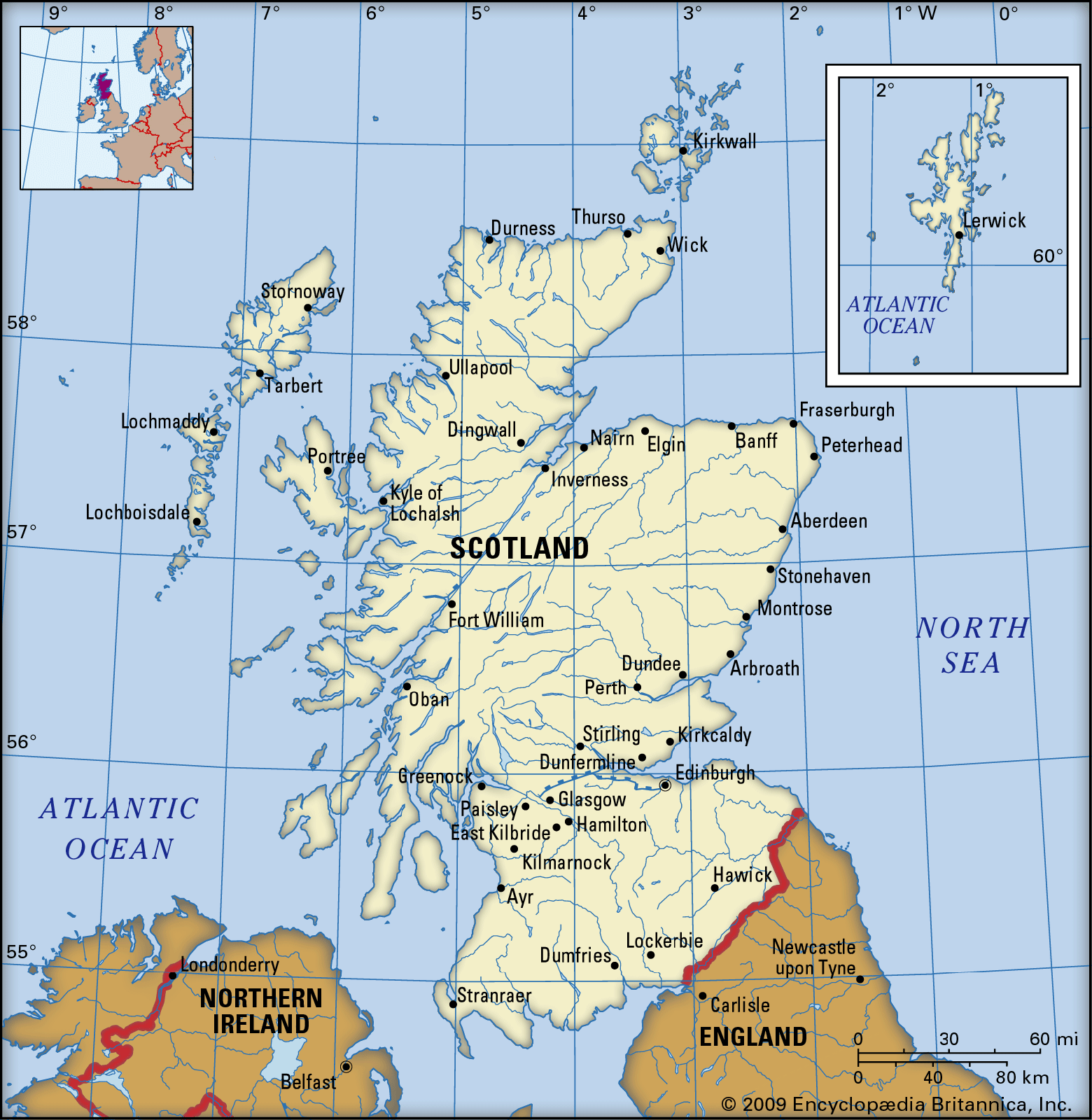


This research undergoes such an exploration, moving beyond seeing community ownership as the signing of a title deed. It invites a critical investigation of the lived reality of the communities on the land post buyout, arguing that true community ownership is not forged in the spectacle of the event, but in the mundane, unglamorous labour of maintenance. It is in this space of participatory governance that environmental identities are strengthened and cultural landed belonging is reclaimed. Drawing on fieldwork then from the Isle of Eigg, Evanton Wood, and Langholm, this article uses lived experience to addresses how these daily, prosaic acts of maintenance, and the complex buy-in they require, actively forge the socio-ecological subjectivities, proving that community ownership is less a legal status and more a lived identity rooted in the labour of stewardship.
The Burden of Administration
I used to make things, and then after the buyout, I spent my whole time in front of a computer.
Participant A
The Scottish government is one of the few places in the Western world which has immortalised the community-right-to-buy (CRtB) in a legislative framework. It grants eligible communities, of up to 10,000 persons, the first right of refusal when land is put up for sale or transferred (Hoffman, 2013). But while Scottish community ownership has increased 10 fold since the start of the century, it remains an arduous undertaking, fraught with structural hurdles and systemic pressures.
A defining financial hurdle for any community buyout sits in the escalating price of land in Scotland, driven by a recent boom in ‘green investment’ and natural capital (Hollingdale, 2022)
| Location | Size in acres | Year of Purchase | Overall Purchase Price | Cost per acre |
| Isle of Eigg | 7,534 | 1997 | £1.5 million | £199 |
| Evanton Wood | 160 | 2012 | £300,000 | £1,875 |
| Langholm Initiative | 10,500 | 2022 | £6 million | £571 |
This immense cost has forced communities into a heavy reliance on a few key funders, most notably the National Lottery Heritage Fund. Discussions in situ revealed that this dependence makes the buyout process incredibly precarious; Eigg’s bid was initially rejected as being too ‘political,’ while Evanton Wood was initially denied because their governance plan did not meet the funder’s criteria. This ‘tick-box exercise’, as one participant termed it, extends deep into the realities of land governance itself.
And there’s a whole tick box exercise to fit the criteria for the various funding.
Participant Ca
By lacking independent monetary capabilities, all three case studies relied on a complex web of external funding from sources like the Empty Homes Initiative, NatureScot, and various woodland trusts. While this reliance on funding is not inherently negative – indeed, Eigg’s pioneering renewable energy grid was only possible through a ‘Big Green Challenge’ grant – it means community on-the-ground priorities and relationships were perpetually shaped by the need to either adhere to external criteria or generate their own income to avoid collapse (BBC News, 2024). On Eigg, the island’s very success had created a dependence on tourism for income, leading to what one described as being a ‘victim of its own success’. In Langholm, the need to secure staff funding directly influenced their strategic focus.
We’re incorporating more corporate volunteering and paid visits into my role because…in order to keep my job, I need to generate income
Participant E
This reality begins to highlight the contextualised nature of community land ownership. While its legal title may be transferred, acquisition does not guarantee agency. The autonomy to build organic socio-ecological relationships is often curtailed by the very structures that funded the buyout. And this is pertinent beyond just monetary hurdles. The Scottish buyout process devolves a significant administrative responsibility also onto the community

Supported by Dinnie and Holstead (2018), it became evident that this administrative compliance was materially shaping communities’ practices. For Eigg, housing development was contingent on renewable energy compliance and beach clean-ups were hampered by a lack of formal government litter recognition. Similarly, Evanton faced ongoing struggles with planning permissions, while Langholm’s rewilding efforts were restricted by NatureScot’s stringent Site of Special Scientific Interest (SSSI) regulations. These constraints did not appear to stem from malicious intent, but from a state bureaucracy ill-equipped to engage with these novel, semi-autonomous bodies. Consequently, navigating this bureaucratic complexity required more than just local passion; it demanded a specific set of professional capabilities, particularly business and administrative acumen (Shaw, 2017). As Participant F made clear, enthusiasm must be guided by experience.
He had great business experience, so I was guided. I was the enthusiast, but they were the business head.
Participant F
This necessity for professional expertise acts as a de facto filter, determining which communities can successfully advance (Mulholland et al., 2015). So a policy originally designed for universal socio-ecological empowerment may, in practice, foster an ‘institutional Darwinism’ (Creamer, 2015), being most accessible to communities already rich in social capital – in the form of residents with business, legal, or administrative expertise – thereby gatekeeping the benefits of ownership from more marginalised groups.
Formation Through The Mundane
But from pressure comes diamonds. Recognising that responsibility is devolved to the local level is crucial for understanding how communities were coming to understand that their land, was in a very real sense, theirs. Firstly, the transference to community governance shouldn’t be romanticised; on Eigg, for instance, early efforts were deemed successful largely because the initial conditions had been so poor.
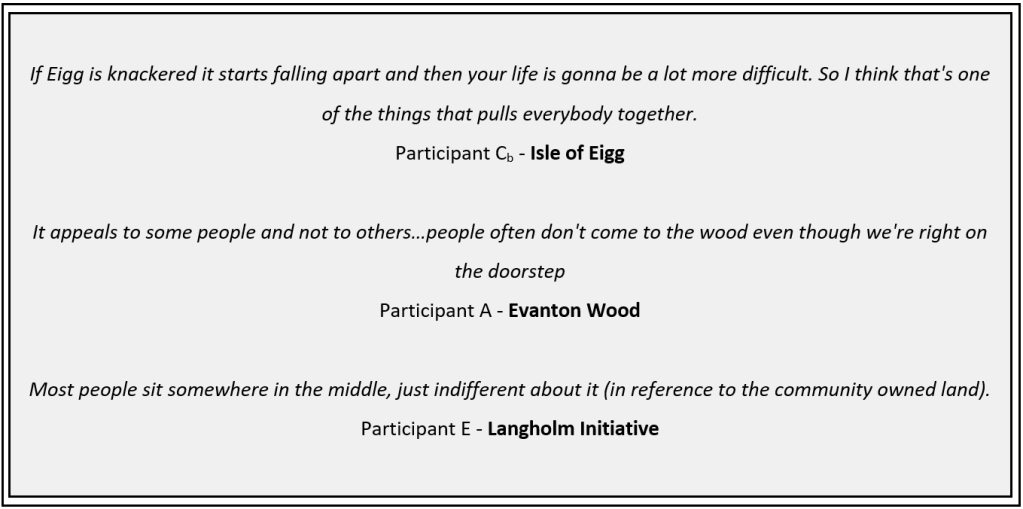
In the beginning, it was really easy. I mean, it sounds funny but because everything was so crap, anything you did was an improvement. Now it’s much harder.
Participant Cb
Community governance’s day-to-day reality placed strain on the population (Danson and Burnett, 2021). This human cost was a constant theme, with interviewees repeatedly citing being at ‘max stretch’ and the critical need for ‘more staff’ or volunteers, admitting that ‘without that input it wouldn’t work’. But while this strain on community governance is, of course, a profound vulnerability, interviews seemed to support the notion that this forced interdependence – hammered out in the difficult, day-to-day work of shared responsibility – is precisely what forges such a strong sense of collective identity (Coser, 1956; Bryden and Geisler, 2007; Rennie and Billing, 2015).
Much of the strain detailed by participants stemmed not from grand projects, but from the relentless weight of what La Grouw et al. (2024) term ‘mundane responsibility’. This dissertation uses the concept to refer to the myriad of ‘small’, essential tasks – perhaps traditionally the purview of local councils – that are devolved to the community through ownership. Each location spoke of the continuous management of signs, maps, seating, path clearing, health and safety protocols, and fence repairs. This burden was amplified on the Isle of Eigg, the only residential site in this study. There, the community was responsible not just for public amenities but for maintaining core infrastructure, including electricity cables, freshwater supplies, broadband access, and housing safety. In these vulnerable spaces, the need to rely on each other is precisely the catalyst that is building community. This resilience doesn’t come from a legal title, but from the mundane responsibility.
While communities engaged with the land in a variety of similar ways, through school groups, volunteer work, and recreation, a deeper interrogation reveals that the motivations underpinning this participation varied dramatically. On the Isle of Eigg, socio-ecological engagement was consistently framed as a matter of existential necessity. The island’s geography and inherent vulnerability meant that active participation was a reciprocal obligation, essential for collective survival. This motivation contrasts sharply with the mainland sites. There, while reciprocity was also mentioned – individuals ‘get something back from it’ – participation remained a choice, driven by a desire for ecological or social benefits rather than a prerequisite for the community’s basic functioning.
This does not devalue these choice-based motivations, but it continues to support the conclusion that the depth of socio-ecological action is ultimately forged less by the legal model of ‘community ownership’ itself, and more by the pre-existing material realities of a place and people – like the existential pressures of island life. Therefore, the primary role of community ownership may not be simply to provide access, but to actively cultivate this sense of shared fate between the people and their place.
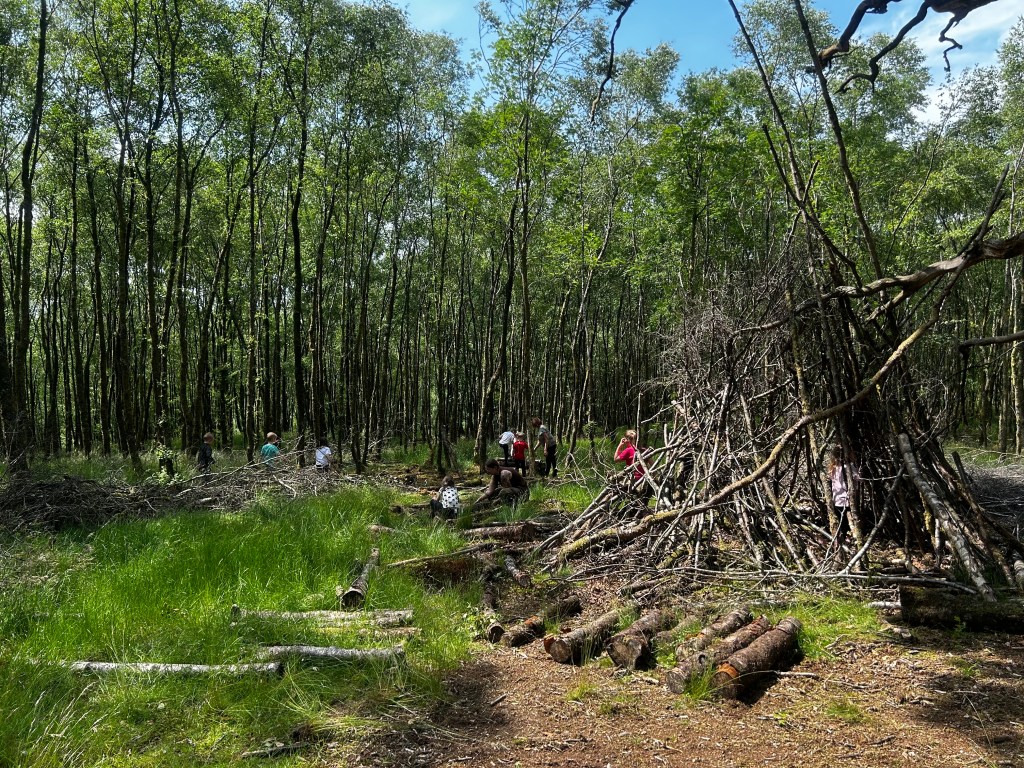
This sense of shared fate was most obvious in the congruent and powerful emphasis placed on children and their education.
You’ve got to start with the kids at a very young age and get it into their head that this is their land. And it’s their future, not ours. Our day is just about over.
Participant F
This commitment was enacted through bespoke educational programs uniquely enabled by the ownership model. On Eigg, Gaelic schooling was used to teach about specific island life, moving beyond generic ‘Highland’ education. In Evanton and Langholm, regular school and youth group sessions focused on practical woodland skills like shelter building, tree identification, and fire lighting. Informed by participation in these sessions, these activities taught more than just practical skills. The children were not just visitors in a public park or on a private estate; they were engaging with a space that was, in a very real sense, theirs.
The more they know and understand about the local area, the more likely they are to protect it.
Local Langholm Brownie leader
Education, therefore, was not simply about learning about the land, but about internalising a sense of belonging, responsibility, and legitimate stewardship (Lave and Wenger, 1991; McLeod et al., 2024). It didn’t come from the title, but was instead forged in the lived participative reality of day-to-day life
Enviornmentality
Which brings this research, therefore, to its final point. Having this participative ecological reality, actually doing the mundane tasks, was turning people into environmental subjects. That same responsibility was working at a deeper, more personal level (Scannell and Gifford, 2010).
What brings awareness…is having to having to take responsibility for your own life and for the environment around you. That awareness is empowering because…you’re then learning the joy that nature can give you
Participant Ba
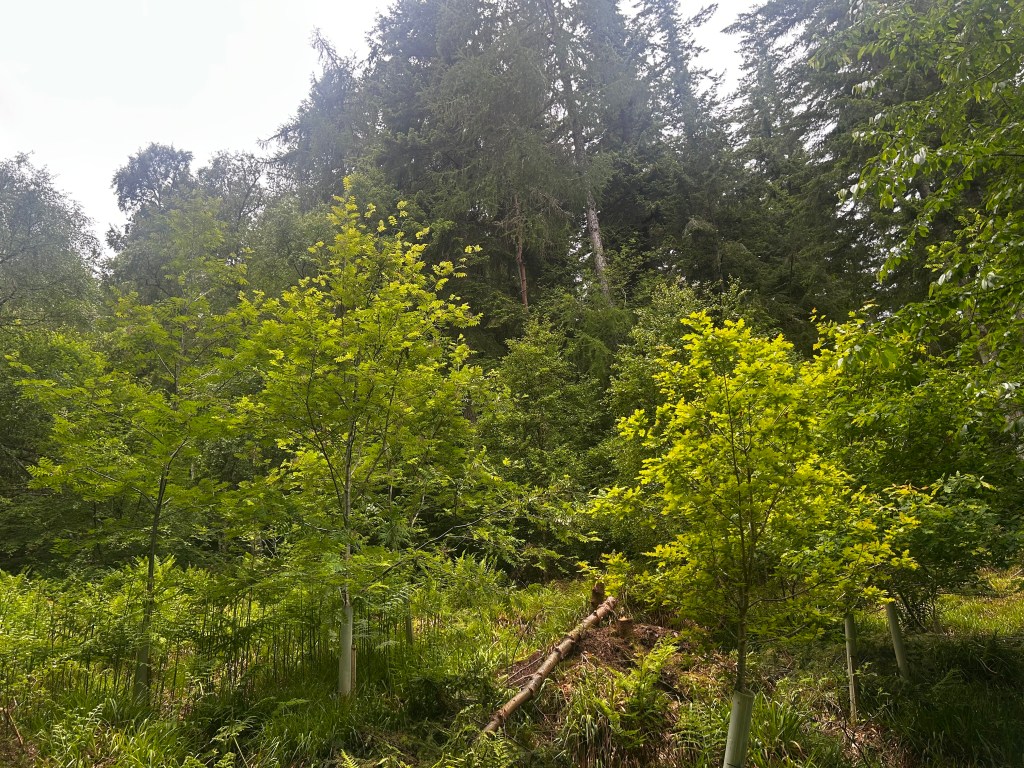
Linked with Agrawal’s ‘enviornmentality’, the lived experience with the land through practical, hands-on stewardship may be assisting the creation of ‘environmental subjects’ (Agrawal, 2005). On Eigg, wildlife WhatsApp groups democratised the collection of ecological data, making knowledge of the island’s biodiversity an inclusive, collective venture. In Evanton Wood, volunteers had to acquire specialised knowledge of tree identification and cropping techniques to appropriately manage the woodland. Perhaps most powerfully, on Langholm’s vast 10,500-acre ‘blank page,’ their very act of surveying and classifying the landscape could be forging a new, intimate relationship with the land, rooted in direct, empirical awareness. Ultimately, here, the mundane is made meaningful through these engagements and the abstract ideal of ‘socio-ecological potential’ becomes a participative ecological reality. You don’t belong to the land because you bought it; you belong because you maintain it
Interestingly though, this sense of forging strong, organic, environmental subjectivities this way, was not shared by everyone. Conversations with a tenanted framer made it clear that for them, vesting the land in a single community entity ‘shuts it down’, preventing a diverse ecosystem of small enterprises from forming their own networks of knowledge and mutual support. They pointed to the Balcaskie Estate, a traditional estate rented to a mixture of tenant farms, as a model that has cultivated its own vibrant, multi-faceted community. This suggests that in replacing one large landowner with a single community entity, the buyout model could risk replicating the same form of socio-ecological exclusivity, inadvertently limiting the very potential for organic, diverse landed communities to emerge.
Conclusion
This research has helped conclude that the socio-ecological power of the Scottish community ownership model lies not in the simple transfer of legal title, but in the complex, lived process it initiates. Supported by existing literature (DTAS, 2012; Mulholland et al., 2015; Sharma, 2023), this complexity continues post-champagne event, exacerbated by the institutional processes, financial realities, and administrative burdens of Scotland’s buyout model. It suggests that these factors are not mere background noises; they are tangible forces that shape this lived experience.
By bringing in the analytical lens of lived reality, we can begin to see how community ownership functions on the ground. It reveals that in the shared, day-to-day struggle of landed engagements and the ‘mundane responsibility’ that community ownership bestows, a renewed socio-ecological relationship is forged (Coser, 1956; Bryden and Geisler, 2007; Rennie and Billing, 2015). It is this continuous and emotive engagement with the land that is the very engine of place-making, a process through which a community’s connection to its landscape can be both newly created and powerfully reclaimed (Davidson et al., 2012; Sultana, 2015; Fry, 2023).
This provides the foundation for what appeared to be the model’s ultimate promise: the long-term cultivation of future custodians – a generation whose relationship with the land is a matter of tangible responsibility, not abstract ideology. Relationships to the land here are not built upon a Lockean notion of property, despite the ownership title; instead offering a freedom to forge bottom-up landed connections. This entrenches more than just a sustainable ‘mindset’ or ‘set of actions’. It fosters a tangible environmental self with a deep-seated desire to steward a land that is rich far beyond its economic value.
So while community ownership is no panacea for our socio-ecological relationship. Its true significance is that it forces a fundamental shift in perspective. In an era of waning trust in centralised institutions, it relocates both agency and responsibility, bringing the abstract scale of our global challenges down to the tangible scale of the local community and the soil underfoot. It does not provide easy answers, but it powerfully poses the most essential question of our time: once given the autonomy to act, what responsibility will we take for the places we call home?
 Newscleus